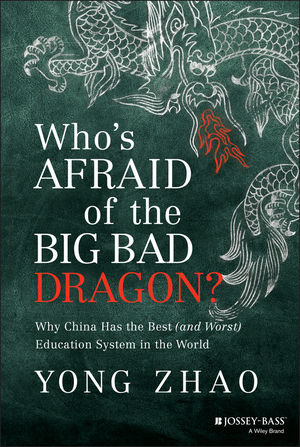
Reviews, Interviews, and News
Diane Ravitch (Nov. 20 2014). The Myth of Chinese Super Schools. New York Review of Books.- Rick Hess (Nov. 13, 2014) Yong Zhao’s Biting Critique of the Chinese Edu-Miracle. Education Week Blog.
Jay Mathews (Sept. 14 2014) Why admiring Chinese test scores might hurt U.S. schools, The Washington Post
Didi Kirsten Tatlow (Sept 14 2014) Q. and A.: Yong Zhao on Education and Authoritarianism in China, The New York Times
Ryan Allen (Oct. 7 2014). New Books in Education, Audio Interview with Yong Zhao.
Jennifer Berkshire (Oct. 6, 2014). Questioning Authoritarianism, an interview with Y. Zhao. EduShyster.
David Wilson (Oct 4 2014). Review of Who’s Afraid of the Big Bad Dragon, South China Morning Post.
- Table of Contents
1 Fooling China, Fooling the World: Illusions of Excellence 13
2 The Emperors’ Game: A Perfect Machine for Homogenization 29
3 Governance without Governing: The Retreat of Authoritarianism and China’s Economic Boom 49
4 Hesitant Learner: The Struggle of Halfway Westernization 71
5 Fooling the Emperor: The Truth about China’s Capacity for Innovation 93
6 Hell to Heaven: The Making of the World’s Best and Worst Education 119
7 The Witch That Cannot Be Killed: Educational Reforms and Setbacks 141
8 The Naked Emperor: Chinese Lessons for What Not to Do 165
Notes 191
Bibliography 217
Index 225


3 responses to “Latest Book: Who’s Afraid of the Big Bad Dragon: Why China has the Best (and Worst) Education System in the World”
Yong Zhao, I’m an award-winning, innovative educator (since 1987) and I think educators, authors and edu-experts continue to bark up the wrong trees in opining about improving education systems at the same time they wish to secure their own systems. In other words, as long as an ethic of conservatism (that which seeks to conserve what is) continues to dominate and control education, there will be very few breakthroughs. With such a dominant ethic test scores are emphasized at the expense of innovating and so the hamster wheel goes ’round and ’round, and our kids and societies are the poorer for it. Corruption seeps in, as bribes or lies, and the band plays on as the ship goes down.
In this day and age, with insights and evidence pouring in from the frontiers of neuroscience, psychology and sociology about how to optimize learning, lifelong, it is within our capability to change the medieval education systems we have, but for the forces lined up to oppose this.
The only country that has truly succeeded in breaking free of this grasp is Finland, to my perception. It’s certainly no Asian, American or other European country, where standardization and centralized control dominate. Deep Sigh.
Best wishes in 2015
– Michael Maser
Dreaming Dragon Consulting(www michaelmaser net)
LikeLike
Is the Chinese education system really one of the best in the world?…
I don’t have first hand knowledge. But I think the answer is that it’s not the best – or it depends on what you think a system should do. According to Yong Zhao, in fact, the Chinese government is acting quickly to try to make it more like what the U…
LikeLike
Ok so if China, South Korea, Japan & Singapore education system not really that good, then what is really good or good enough? Estonia? India? Brazil? South Africa? Syria? Sweden? Vietnam? Pakistan? North Korea? How can we justify what is regarded as really good? Reasoning? Evidence? Foreknowledge?
Is Jaime Escalante approach/methods better or worse than Freida Riley. What about Ron Clark or Ken Carter?
LikeLike